The Living World
Biology Chapter 1: Explore the amazing diversity of life forms, taxonomy, and classification systems in this interactive study guide.
Chapter Overview
Introduction
Biology is the science of life forms and living processes. The living world comprises an amazing diversity of living organisms. This chapter introduces the fundamental concepts of biodiversity, taxonomy, and classification systems.
Key Learning Objectives
- Understand the diversity in the living world.
- Learn the need for classification.
- Study taxonomic categories and hierarchy.
- Comprehend binomial nomenclature.
1. Diversity in the Living World
The number of species that are known and described range between 1.7-1.8 million. This refers to biodiversity.
Why do we need to classify organisms?
- To study the vast diversity of organisms systematically.
- To understand the inter-relationships among different organisms.
- To overcome the confusion created by local names.
Classification is essential because:
- It helps in the identification of organisms.
- It reveals evolutionary relationships.
- It organizes vast amounts of data into manageable categories.
2. Binomial Nomenclature
Given the vast variety of organisms, naming them uniformly is crucial. Binomial Nomenclature was introduced by Carolus Linnaeus.
- Biological names are generally in Latin and written in italics.
- The first word represents the Genus (capitalized).
- The second word is the Specific Epithet (lowercase).
- Example: Mangifera indica (Mango).
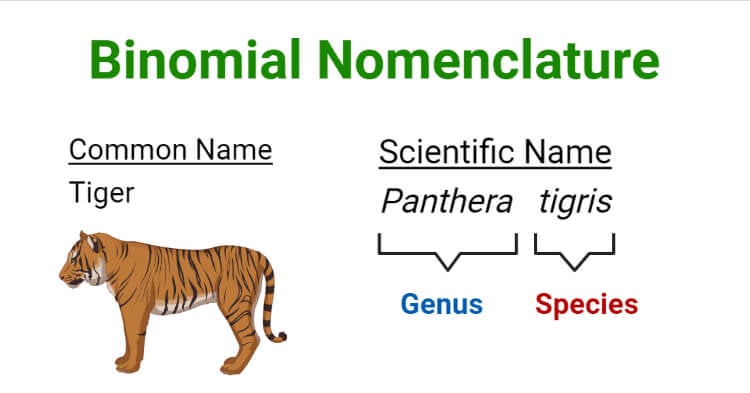
Figure: Representation of Binomial Nomenclature
3. Taxonomic Categories
Taxonomic categories are a hierarchical rank in the classification of organisms.
Species
Group of individuals with fundamental similarities. E.g., Homo sapiens.
Genus
Group of related species. E.g., Panthera (lion, tiger, leopard).
Family
Group of related genera. E.g., Felidae (cats).
The hierarchy proceeds to Order, Class, Phylum/Division, and Kingdom.
4. Taxonomic Hierarchy Example
Observe how the Human (Homo sapiens) is classified taxonomically:
| Rank | Human | Mango | Wheat |
|---|---|---|---|
| Kingdom | Animalia | Plantae | Plantae |
| Phylum/Division | Chordata | Angiospermae | Angiospermae |
| Class | Mammalia | Dicotyledonae | Monocotyledonae |
| Order | Primates | Sapindales | Poales |
| Family | Hominidae | Anacardiaceae | Poaceae |
| Genus | Homo | Mangifera | Triticum |
| Species | sapiens | indica | aestivum |
NCERT Solutions
A: Classification helps in organizing the vast diversity of life, establishing relationships among organisms, and making identification easier. It provides a universal language for biologists.
A: Systems change due to the discovery of new species, new information from molecular biology (DNA sequencing), and improved understanding of evolutionary relationships.
A: Mangifera indica. The Genus (Mangifera) starts with a capital letter, and the species epithet (indica) starts with a small letter. Both should be italicized.
Practice Quiz
1. The term 'systematics' refers to:
Correct Answer: (c) Diversity of kinds of organisms and their relationships.
2. Which is the correct scientific name for Human?
Correct Answer: (b) Homo sapiens. Genus capitalized, species lowercase.
Answer: A taxon is a unit of classification representing a rank or category in the taxonomic hierarchy. Examples: Panthera (Genus), Mammalia (Class), Animalia (Kingdom).
Interactive Flashcards
Click the card to flip it!
What is binomial nomenclature?
(Click to see answer)
A system of naming organisms with two components: Generic name and specific epithet. E.g., Homo sapiens.
Download Resources
Rate This Article
Thanks for reading: , Stay tuned for the latest study tips, exam strategies, and educational resources to boost your learning journey!